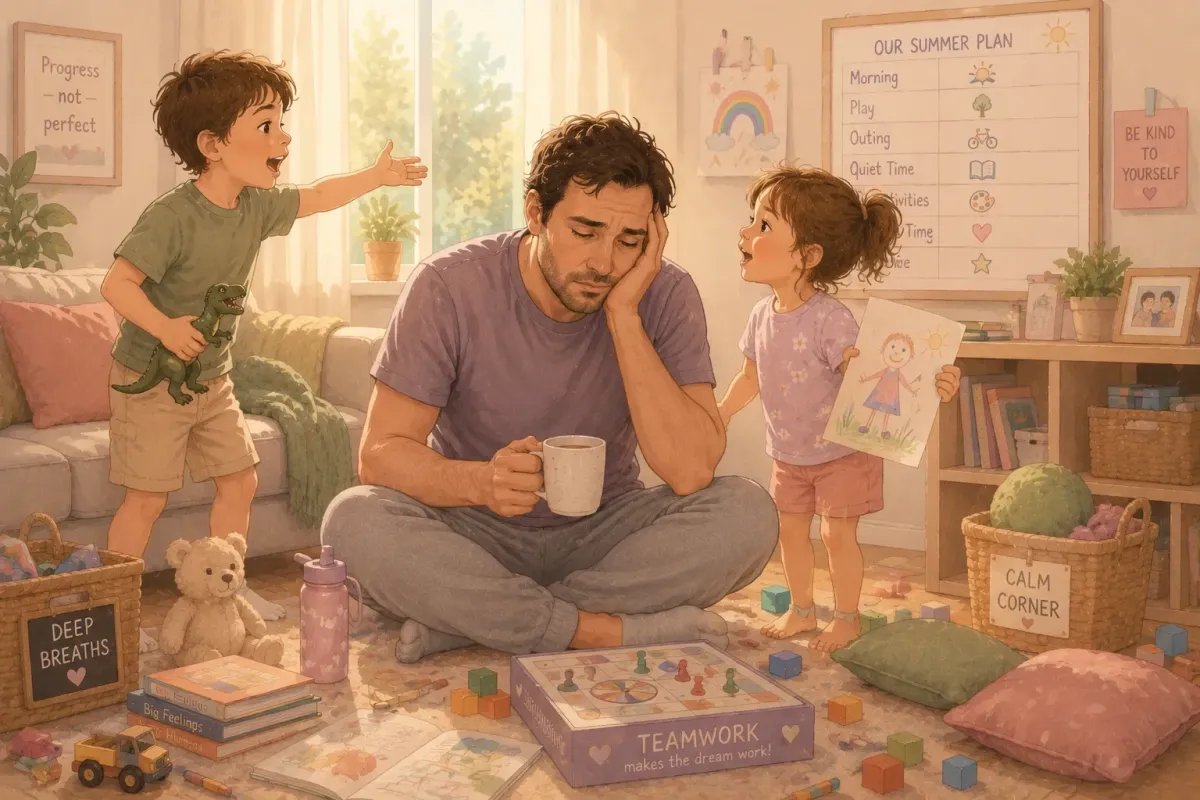
My Child's Behaviour Gets Worse in the School Holidays: Why, and What Actually Helps
Children's behaviour often gets worse in the school holidays because school provides the structure, routine, and predictability that many children rely on to feel calm and regulated. Without it, particularly in children who are sensitive to change, have ADHD, anxiety, or simply thrive on knowing what comes next, the nervous system becomes unsettled and behaviour deteriorates. This is not naughtiness. It is dysregulation. The good news is that understanding the reason makes the solution much clearer. You do not need to recreate school at home. You need to create enough loose structure and connection to help your child's nervous system feel safe again. This article explains exactly why the holidays are hard for so many children, what is going on beneath the surface of the behaviour, and the specific, practical steps that help most. It also addresses the reality of how hard the holidays are for parents, without any guilt attached.
Introduction: Why the School Holidays Can Feel Like a Different Child

You count down to the school holidays. Then they arrive, and within forty-eight hours you are wondering how you are going to survive the next six weeks. Your child, who apparently behaved perfectly at school all term, is now melting down over the wrong colour cup, fighting constantly with their sibling, and bouncing off the walls by nine in the morning.
You are not imagining it. And you are not alone. This is one of the most common things parents raise with Bakshi Sidhu, a certified conscious parenting coach, former primary school teacher of over ten years, and nursery owner. The holidays strip away the external scaffolding that many children depend on, and what you see in the aftermath is their nervous system struggling to cope.
This article explains the real reasons behind holiday behaviour changes, which children are most affected and why, and the practical strategies that make a genuine difference - for your child, and for you.
Why Do Children's Behaviour Get Worse in the School Holidays?
The role of routine in children's emotional regulation
Routine is not just about convenience. For children, predictability is a form of emotional safety. When a child knows what is happening next, their nervous system does not have to stay on high alert scanning for what is coming. The school day, for all its demands, provides a highly predictable structure: wake up at this time, do these things in this order, arrive at school, follow this timetable, come home, have this snack, do this activity, go to bed at roughly this time.
When the holidays begin, that entire framework disappears. Days have no fixed shape. Mealtimes drift. Bedtimes shift. There is no socially enforced schedule to anchor the day. For many children, especially those with a sensitive nervous system, this is genuinely destabilising.
The resulting behaviour - meltdowns, aggression, clinginess, boredom, constant demands - is not the child choosing to be difficult. It is the child's nervous system communicating that it is overwhelmed.
Which children are most affected by the loss of school structure?
While almost all children show some behaviour change in the holidays, certain children are significantly more affected:
- Children with ADHD, who rely on external structure to manage attention and impulse control
- Children with anxiety, for whom predictability is a key coping mechanism
- Children with sensory processing sensitivities, who find the increased noise, chaos, and unpredictability of holiday life overstimulating
- Children who are autistic, for whom routine changes can be particularly distressing
- Younger children, whose capacity for self-regulation is still developing and who depend more heavily on the adults around them to co-regulate
If your child falls into any of these categories, the intensity of holiday behaviour change can be significant. It does not mean something has gone wrong. It means your child needs more intentional support during unstructured time.
Why Is My Child Well-Behaved at School But Impossible at Home?

This is the question that confuses and frustrates so many parents. The school reports are glowing. The teacher says your child is a delight. And yet at home, particularly in the holidays, they are completely different.
There is a well-understood explanation for this, sometimes called the safe haven effect. Children spend enormous amounts of energy holding themselves together in environments where they feel they need to perform, comply, or manage social demands. School requires children to sit still, follow instructions, manage peer relationships, regulate their emotions in front of others, and suppress the full force of their needs for several hours a day.
By the time they get home - or by the time the holidays stretch out with no school structure to contain them - all of that pent-up tension needs somewhere to go. Home is where they feel safe enough to release it. You, as their trusted adult, are the person they trust enough to fall apart in front of.
This does not make it easier to manage. But it does reframe it. Your child's worst behaviour at home is not ingratitude or manipulation. It is, in a very real sense, an expression of trust. The challenge is giving them better ways to release that tension than meltdowns and aggression.
What Happens to Children's Bodies During the School Holidays?
It is worth understanding what is happening neurologically, because it makes the strategies much more logical.
The brain's stress response system, the amygdala, is highly sensitive to unpredictability and uncertainty. When children lose the predictability of their school routine, the amygdala can go into a low-level state of alert. This is not full-blown panic. But it is a background hum of unsettledness that makes it much harder to manage frustration, wait for things, share, and regulate emotions.
In children with ADHD, this is compounded by the fact that external structure effectively does some of the work of the prefrontal cortex - the part of the brain responsible for planning, impulse control, and emotional regulation. Without that external scaffold, the ADHD child's own regulatory systems have to do more work, and they often cannot sustain it.
In children with anxiety, the removal of predictability can activate what is sometimes called anticipatory anxiety - a constant background scanning for what might happen next. This can look like clinginess, hypervigilance, excessive questions, and irritability.
Understanding this means you stop trying to reason with a child who is already dysregulated, and start focusing instead on what their nervous system actually needs to come back down.
How Much Structure Does a Child Actually Need in the School Holidays?
Loose predictability, not a rigid timetable
The answer is not to recreate school at home. Children need the holidays to feel different from school - less pressure, more freedom, more spontaneity. But they also need enough predictability that their nervous system can relax.
The goal is what you might call loose predictability: a consistent shape to the day without a minute-by-minute schedule. This means:
- Waking up at a similar time each day, even if it is later than during term time
- Having regular mealtimes that anchor the day
- A rough morning and afternoon shape, even if the activities within them vary
- A consistent bedtime, or at least a consistent wind-down routine, even if actual sleep is slightly later
Within that loose structure, there can be plenty of freedom, spontaneity, and child-led time. The structure is not the content of the day - it is the skeleton that holds the day together.
The difference between boredom and dysregulation
It is worth distinguishing between a child who is bored and a child who is dysregulated. Boredom is uncomfortable but not harmful, and children who learn to tolerate and move through boredom develop important capacities for creativity and self-direction. Dysregulation is different. It is a nervous system state in which the child cannot access their rational brain, and attempting to reason with or entertain a dysregulated child is largely ineffective.
The signs of dysregulation include: extreme emotional reactions to small things, aggression, crying that seems disproportionate, inability to make decisions, clinging, shouting, or complete shutdown. When you see these signs, the priority is regulation, not activity. Connection before correction, and calm before problem-solving.
Practical Strategies for Managing Child Behaviour in the School Holidays
Before the holiday starts
The single most effective thing you can do is prepare rather than react. In the days before the holidays begin, spend fifteen minutes with your child co-creating a loose holiday rhythm. Not a timetable. A rhythm. What will mornings generally look like? When will screens be available? Is there one thing each week they are looking forward to?
Having this conversation in advance means your child's nervous system has already processed some of the uncertainty before it arrives. It also gives them a sense of agency, which reduces resistance significantly.
During the holiday: connection is the foundation
Behaviour in the holidays often deteriorates not just because of lost structure, but because of lost connection. During the school term, children have daily goodbyes and reunions, homework time together, bedtime routines - multiple daily moments of focused attention from you. In the holidays, paradoxically, children can actually receive less focused one-to-one attention despite being around you more.
Aim for at least ten to fifteen minutes of genuine, child-led, one-to-one connection with each child every day. Not organised activity. Not screens together. Just following their lead and being fully present. Research consistently shows that this kind of daily connection significantly reduces attention-seeking behaviour and emotional meltdowns.
When things escalate: what actually helps
When your child is already in meltdown, the priority is not consequences. It is co-regulation. Your calm nervous system can help regulate theirs. This means:
- Lowering your own voice and slowing your movements, which signals safety rather than threat
- Getting physically lower than your child if you can, crouching or sitting, rather than standing over them
- Offering physical closeness if they accept it, without forcing it
- Saying less rather than more - a dysregulated child cannot process complex language
- Waiting until calm before any discussion of what happened or what the consequences are
This is genuinely hard when you are also on your fourth hour of the holidays and running on empty yourself. Which is why your own regulation matters just as much as your child's.
Sibling Conflict in the School Holidays: Why It Spikes and What to Do

Sibling fighting in the school holidays is almost universal, and it makes sense when you understand the dynamics. Children who spend most of the school day apart are suddenly together for twelve or more hours a day with no structured activity to absorb their energy. Add dysregulation from lost routine and you have a situation primed for conflict.
Strategies that genuinely reduce sibling conflict in the holidays include:
- Separate one-to-one time with each child, which reduces the competition for your attention that drives much sibling conflict
- Creating physical spaces where each child can have time alone when they need it
- Having a consistent conflict response that you use every time, which removes the unpredictability of your reaction from the equation
- Not asking children to resolve conflict entirely themselves, but scaffolding it: 'I can see you both feel strongly about this. Let's all sit down and you can each tell me what happened'
The article on how to handle sibling fighting without yelling on this site goes into much more detail on specific approaches: https://littleoneslifecoach.com/post/how-to-handle-fighting-siblings-without-yelling
Screen Time in the School Holidays: How to Avoid Daily Arguments
Screen time is one of the biggest sources of conflict in the school holidays, and the arguments tend to follow a predictable pattern: no clear limit is set in advance, the child pushes for more, the parent says no, conflict escalates.
The most effective approach is to agree a simple framework before the holiday begins, when everyone is calm, and then hold it consistently. This does not have to be a complex system. It might simply be: screens after breakfast and before lunch, then again after four o'clock. The specifics matter less than the consistency.
When children know the rule in advance and it is applied consistently, the argument reduces significantly. The daily negotiation is what drains everyone, not the limit itself.
What If You Are the One Struggling to Cope in the School Holidays?
This is important to name, because parenting advice often focuses entirely on the child while ignoring the reality of the adult who is managing all of this. The school holidays are hard for parents. Particularly for parents who are also working, who have a child with additional needs, who are managing on their own, or who simply have limited support around them.
If you are finding yourself losing your temper more than you want to, dreading the next day, or feeling resentful of your children during the holidays, that is not a character flaw. It is a sign that you need more support and more capacity.
The article on recognising and recovering from mum burnout explores this in depth: https://littleoneslifecoach.com/post/mum-burnout-is-real-how-to-recognize-it-and-recharge
And if you find yourself shouting more than you want to, the article on how to stop yelling at your child offers compassionate, practical guidance: https://littleoneslifecoach.com/post/how-to-stop-yelling-at-your-child
The most important thing you can do for your child's behaviour in the school holidays is to protect your own regulation. A parent who is regulated, even imperfectly, creates a safer emotional environment than a parent who is running on empty and performing patience they do not have.
How to Build Emotional Intelligence During the School Holidays
The holidays, for all their challenges, also offer something the school term rarely does: unscheduled time for genuine emotional connection and learning. When the pressure is off, children are more available for the kinds of conversations that build emotional intelligence.
Some of the most powerful things you can do:
- Name emotions as they arise, in yourself and in your child, without judgement
- Wonder aloud about feelings rather than interrogating: 'I wonder if you are feeling frustrated because you wanted more time on the game' opens a conversation rather than closing one
- Model your own emotional regulation by narrating it: 'I am feeling a bit overwhelmed right now so I am going to take three deep breaths before I answer that'
- Repair after conflict rather than moving on quickly - a genuine repair conversation teaches children far more about relationships than a smooth interaction
Building your child's emotional vocabulary and emotional intelligence now will pay dividends in their ability to manage school, friendships, and life. The article on how to foster emotional intelligence in young children covers this in more depth: https://littleoneslifecoach.com/post/how-to-foster-emotional-intelligence-in-young-children--techniques-to-help-children-understand-and-manage-their-emotions
Conclusion: The Holidays Are Hard. That Does Not Make You a Bad Parent.
If your child's behaviour gets worse in the school holidays, the most important thing to take from this article is that there is a reason, and it is not about you, and it is not about them being a bad child. It is about nervous systems, structure, and the biology of emotional regulation.
You cannot magic away the challenge of the holidays. But you can reduce it significantly by building in enough loose predictability to help your child's nervous system settle, prioritising connection over activity, and taking your own capacity as seriously as your child's needs.
The holidays will still be hard sometimes. But they do not have to be something you dread. With the right understanding and the right strategies, they can also contain some of the most connected, joyful moments of your year.
Related Articles You Might Find Helpful
- How to Handle Sibling Fighting Without Yelling - https://littleoneslifecoach.com/post/how-to-handle-fighting-siblings-without-yelling
- Mum Burnout Is Real: How to Recognise It and Recharge - https://littleoneslifecoach.com/post/mum-burnout-is-real-how-to-recognize-it-and-recharge
- How to Stop Yelling at Your Child - https://littleoneslifecoach.com/post/how-to-stop-yelling-at-your-child
- How to Foster Emotional Intelligence in Young Children - https://littleoneslifecoach.com/post/how-to-foster-emotional-intelligence-in-young-children--techniques-to-help-children-understand-and-manage-their-emotions


