My Child Says They Hate School: What Is Really Going On?
If your child says they hate school, it is rarely about being lazy, dramatic, or difficult. When a child says they hate school, they are usually telling you that something there feels too big to cope with on their own. The real reasons tend to fall into a few groups: anxiety or worry, friendship and social difficulties, work that feels too hard or too easy, sensory overwhelm, an unmet need such as undiagnosed ADHD, bullying, or a transition they have not settled into yet. The words are the signal, not the whole story. The most helpful response is to stay calm, get curious rather than corrective, notice when and where the feeling started, and work gently with the school to find the cause. This guide explains what "my child hates school" really means, the most common reasons behind it, when it might be school refusal, and the practical steps that help your child feel safe enough to go back.
First, You Are Not Failing as a Parent

Hearing your child say "I hate school" can land like a punch, especially on a busy morning when you are already running late. You might feel a flash of worry, frustration, or guilt, sometimes all three at once. None of that makes you a bad parent. It makes you a parent who cares.
Bakshi Sidhu is a certified conscious parenting and life coach, a former primary school teacher of more than ten years, and a nursery owner. Helping parents understand what is going on underneath a child who suddenly dreads school is one of the most common things she is asked about. The reassuring truth is that "I hate school" almost always has a reason, and once you understand the reason, you can start to help.
This guide walks you through what your child may really be saying, the most common causes, how to tell an ordinary wobble from something that needs more support, and the gentle, practical steps that make the biggest difference.
What Does It Mean When My Child Says They Hate School?
Children do not always have the words for big, complicated feelings. "I hate school" is often the simplest sentence they can reach for when something inside feels like too much. It is shorthand, not a considered verdict on their education.
When a child says they hate school, the feeling underneath is usually one of these:
•I feel worried and I do not know how to explain it
•Something happened that I do not know how to tell you
•The work is too hard and it makes me feel stupid
•The work is too easy and I feel bored and switched off
•It is too loud, too bright, or too busy for me
•I do not have anyone to play with
•I am tired and my body just cannot cope today
Reading the words as information rather than rudeness changes everything. Instead of arguing about whether they really hate school, you get curious about what the feeling is pointing to.
Why Does My Child Hate School? The Most Common Reasons

There is rarely a single cause. More often it is a mix. Here are the reasons that come up most often for UK primary and early secondary children.
They feel anxious about school
Anxiety is one of the most common reasons a child says they hate school. A child who is anxious about school might complain of tummy aches or headaches that ease by mid-morning, struggle to settle on a Sunday night, or cling at the gate. The NHS notes that many children feel anxious about schoolwork, teachers, or being away from home, and that this often shows up as physical symptoms rather than the words "I am worried." If your child seems tearful or panicky rather than defiant, anxiety is worth considering first. Our guide on what to do when your child will not stop crying explores this in more depth.
Friendship and social difficulties
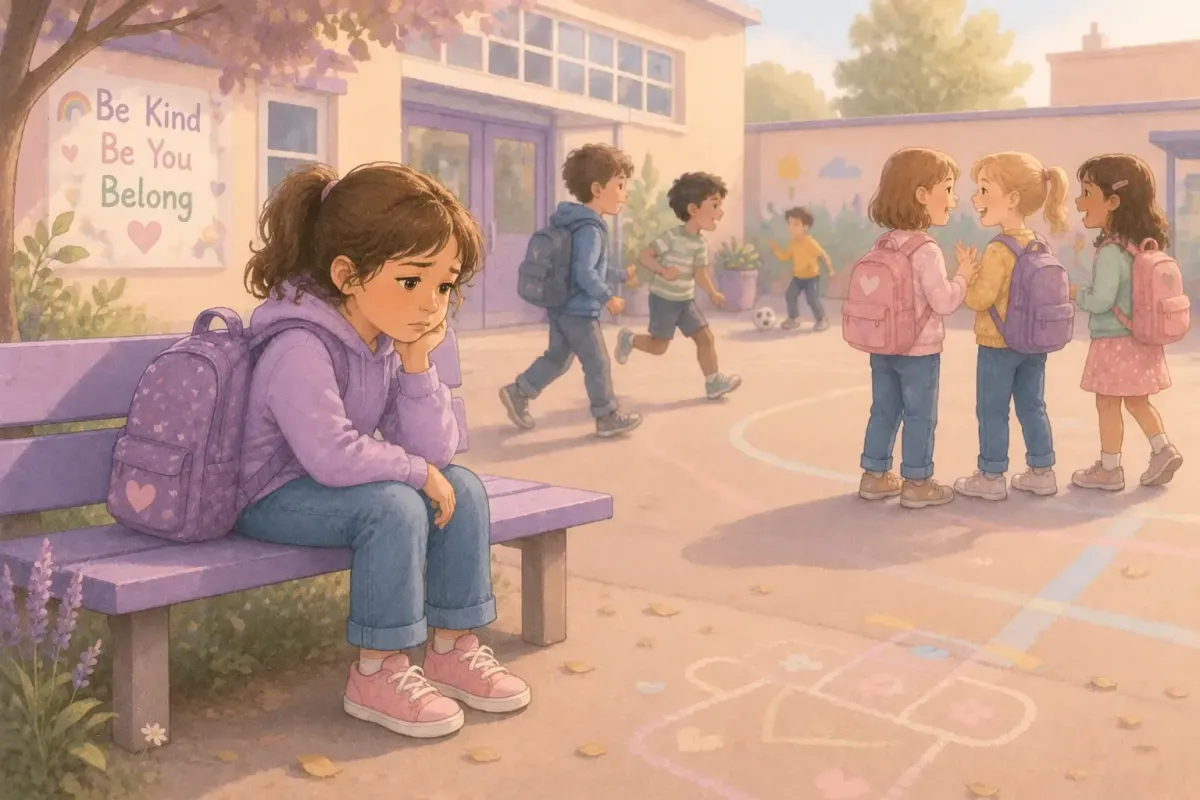
For many children, school is mostly about the other children. A fallout with a best friend, feeling left out at playtime, or not knowing how to join in can make the whole day feel unbearable. Younger children often cannot explain this clearly. They simply know that school feels lonely or unsafe right now, so they decide they hate it.
The work feels too hard, or too easy
A child who is quietly struggling to keep up can feel exposed and on edge in every lesson. A child who finds the work far too easy can feel bored, restless, and disconnected. Both can lead to the very same sentence. This is especially worth exploring if the dislike is stronger for particular subjects or particular days of the week.
Sensory overwhelm and unmet needs such as ADHD
School is a loud, bright, fast, socially demanding place. For a child with a sensitive nervous system, or with a neurodiverse profile such as ADHD or autism that has not yet been recognised, a full day can be genuinely exhausting. Young Minds points out that school can feel especially tiring and stressful when a child's needs are not yet diagnosed or supported. In these cases, "I hate school" often really means "I cannot cope with how this feels for six hours."
Bullying
Sometimes "I hate school" is the only safe way a child can hint that something is wrong without naming it. Bullying can be subtle, including being left out, teased, or made to feel small, and children often hide it out of embarrassment or fear of making it worse. If your child has become withdrawn or upset about specific days or specific people, our guide on how to check if your child is being bullied can help you spot the signs gently.
A recent change or transition
A new class, a new teacher, a house move, a new sibling, or moving up a key stage can all unsettle a child enough that school suddenly feels too much. Bigger jumps, such as starting secondary school, are especially common triggers. If a transition is on the horizon, our guide on preparing your child for secondary school offers practical, calming steps.
Is This School Refusal, or Just a Bad Week?
Most children grumble about school sometimes. The question is whether you are seeing an ordinary wobble that passes, or something that is building. The table below can help you tell the difference at a glance.
When anxiety builds to the point that a child genuinely cannot get to school, it is sometimes called school refusal, or emotionally based school avoidance. This is not a child being naughty or simply choosing to stay home. If you are seeing several signs from the right-hand column, especially if your child wants to please you but still cannot manage it, it is worth speaking to your child's teacher or SENCO and to your GP. Early, gentle support tends to work far better than waiting.
What Should I Do When My Child Says They Hate School?

You do not need to fix everything in one conversation. The goal is to help your child feel understood and safe, then take small, steady steps. Here is where to start.
Stay calm and get curious
Try to meet "I hate school" with calm curiosity rather than reassurance that rushes the feeling away. Lines like "That sounds really hard, tell me more" or "What is the trickiest bit of the day?" invite your child to open up. Avoid quizzing them at the school gate, where there is no time or privacy. A relaxed moment, such as a car journey, bath time, or a walk, often works better.
Look for the pattern
Notice when the dread is strongest. A few questions can reveal a lot:
•Is it certain days, lessons, or times of day?
•Is it worse after weekends, holidays, or a particular event?
•Is it about a person, the work, the noise, or being away from you?
Patterns turn a vague "I hate school" into something specific you can actually address.
Work with the school, not against it
Your child's teacher, pastoral lead, or SENCO are your allies. Share what you are seeing at home, ask what they notice in class, and agree a simple plan together. Many schools can offer a quiet space, a check-in with a trusted adult, a buddy at playtime, or small adjustments that make the day feel safer.
Keep mornings calm and connected
Hard mornings can set the tone for the whole day. A predictable, unrushed routine, a few minutes of warm connection before you part, and a clear plan for what happens at pick-up can all lower the pressure. The aim is to help your child's nervous system feel that school is survivable, then steadily, that it is okay.
Hearing "I Hate School" Is the Start, Not the End
When your child says they hate school, it can feel frightening, but it is also useful information. It is your child trusting you with a feeling they cannot yet manage alone. Behind the words is almost always something understandable: worry, a friendship, the work, the noise, a change, or a need that has not been spotted yet.
You do not have to have all the answers today. Stay calm, get curious, look for the pattern, and bring the school alongside you. Most children who say they hate school can, with patient and consistent support, find their way back to feeling safe there. And if you would value a calmer, clearer plan, you do not have to work it out on your own.
Related Posts
My Child Won't Stop Crying: Is It Anxiety or Something Else?
How Can I Check If My Child Is Being Bullied at School?
My Child Is Having a Meltdown Over SATs: What Do I Do?
How to Prepare Your Child for Secondary School (Without the Panic)


