My Child Has No Friends - What Do I Do? Parents guide 2026
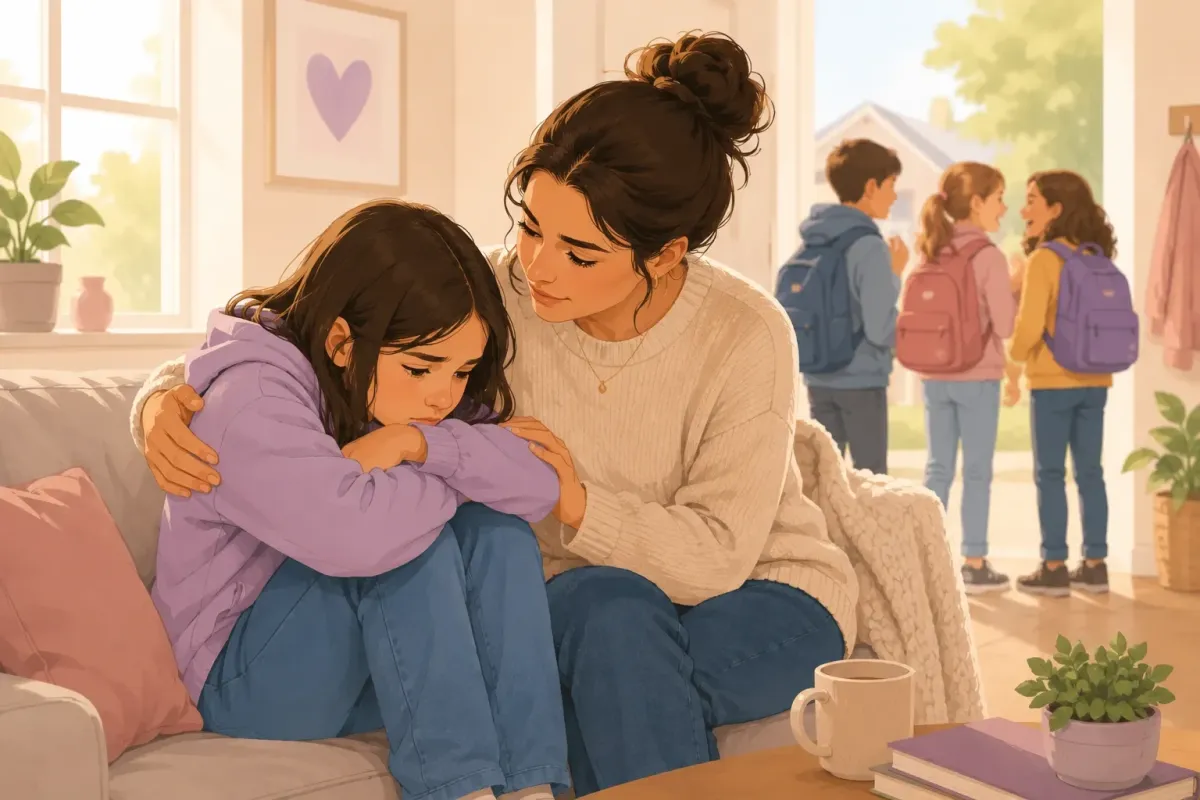
If you have ever picked your child up from school and seen them walk out alone - while other children leave in pairs and groups, laughing about something that happened at lunch - you will know the particular heartbreak of that moment. You say nothing. You smile at them. But inside, you are asking the question that brings many parents to this page: my child has no friends. What do I actually do?
You are not alone in asking it. Research from the University of Michigan found that nearly one in five parents say their child aged 6 to 12 has no friends or not enough friends. In the UK, data from the Office for National Statistics found that more than 11% of children aged 10 to 15 report often feeling lonely - and that figure rises significantly for children in cities and children with additional needs.
This is a more common experience than the school gate would suggest. Most parents keep it private. Most children don't have the language to tell you how bad it feels. And the advice that tends to circulate - "just sign them up for a club" - barely touches the surface of what's actually going on.
In this article I want to help you understand why some children struggle to make and keep friends, what the most common mistakes parents make look like (all of them well-intentioned), and what genuinely helps - from a parent who spent over a decade watching children navigate peer relationships in primary school classrooms, and now works with families when those relationships break down.
Why some children find friendships harder than others
Before anything else, it helps to move away from the idea that a child who has no friends is doing something wrong - or that you are. Friendship is a skill, and like all skills, some children acquire it more easily than others. The reasons are varied, and understanding which one applies to your child is the starting point for everything that follows.
Temperament and social anxiety

Some children are simply wired to be more cautious, more inward, and more easily overwhelmed by the social demands of a busy classroom or playground. For a highly sensitive child, the noise and unpredictability of group play can be genuinely exhausting rather than exciting. They may want connection deeply but find the process of initiating it terrifying. This is not shyness as a character flaw. It is a nervous system that processes social information more intensely than average.
Social skills gaps
Making and keeping friends requires a specific set of skills: reading social cues, taking turns in conversation, managing the impulse to dominate play, repairing after a conflict, knowing how to enter a group that is already playing. These skills are not innate - they are learned. Children who haven't yet developed them, or who have developed them unevenly, will find peer relationships harder. This is particularly common in children with ADHD, autism, or developmental differences, but it also applies to children who have simply had fewer opportunities to practice.
Social rejection and reputation
Some children are not just without friends - they are actively rejected by their peers. This is qualitatively different from simply being quiet or unnoticed, and it requires a different response. Peer rejection at primary school age can become self-reinforcing: the child develops a reputation, other children follow the social lead of dominant peers, and the child's own behaviour shifts in response to the rejection - often in ways that make things worse, not better.
The hidden role of neurodivergence

ADHD and autism both affect the way children navigate social situations in ways that are often invisible to adults but acutely visible to peers. A child with ADHD may interrupt, dominate, and struggle to read when a joke has gone too far. An autistic child may have genuinely different social interests and communication styles that are not a match for their neurotypical classmates. Neither of these things means friendships are impossible - but they do mean that standard friendship advice will only go so far without also addressing the neurological dimension underneath.
Something that happened
Sometimes a child who previously had friends loses them following a specific event - a falling-out, a move, a change of class, a shift in the social dynamics of their year group. The loss is real and should be named as such. Children grieve friendships. Treating it as a practical problem to solve before it has been acknowledged as a loss misses the emotional work that needs to happen first.
What it feels like for your child - and why they often won't tell you
One of the most painful aspects of childhood loneliness is that children are frequently unable or unwilling to tell their parents the full extent of it. They may say "it's fine" when it isn't. They may describe a peripheral acquaintance as a friend because the truth feels too shameful to say out loud. They may not have the emotional vocabulary to articulate what it feels like to sit alone at lunch every day, or to watch a group game and not know how to join it.
What you might notice instead: reluctance to go to school that isn't explained by anything obvious, coming home flat or irritable rather than energised, not mentioning any names when you ask about their day, asking repeatedly if they can have a phone so they can "keep in touch with people," inventing illnesses on days when social situations feel most exposing, spending increasing amounts of time alone in their room or on screens.
Screens deserve a specific mention here. Many parents worry that screens are replacing friendships. In many cases it is the other direction - a child who has no friends in real life retreats to online games or social media not as the cause of their isolation, but as a response to it. The online world provides social interaction without the unpredictability and rejection risk of the playground. Understanding this reframes the screen time debate significantly.
The difference between "no friends" and "one friend"

Research on childhood friendship consistently shows that the most protective factor is not the number of friends a child has, but whether they have at least one mutual, reciprocal friendship - a person who specifically chooses them back. A child with one true friend is significantly better protected against the effects of loneliness than a child who is broadly liked but has no one who is particularly theirs.
This matters practically because it changes the target. The goal is not to make your child popular. The goal is to help them find one person who gets them.
What not to do - the well-meaning responses that backfire
Telling them it will get better
"Everyone finds it hard to make friends sometimes" and "you'll find your people soon" are not untrue - but to a child sitting alone at lunch every day, they feel dismissive. They are also not actionable. Hear the feeling before you offer the perspective.
Forcing social situations
Organising playdates with children your child has never mentioned, signing them up for activities they didn't choose, arranging things "for their own good" that they haven't consented to - all of these can increase social anxiety rather than reduce it. The experience of being pushed into social situations where they then fail to connect reinforces the belief that they are somehow socially defective.
Rescuing rather than coaching
When a child comes home and says "no one played with me today," the parental instinct is to fix it - call the school, call the other parents, sort it out. This is sometimes right, but often it removes the child's agency from a situation that needs to be theirs to navigate (with your support). The question "what do you think you could do?" is often more useful than "I'll speak to the teacher."
Projecting your own feelings onto the situation
If watching your child without friends is activating something in you - your own memories of loneliness, your fears about their future, your sense of having failed them in some way - those feelings are real and worth processing. But if they come into the conversation with your child, they add weight to an already heavy situation. Your child needs you regulated and curious, not visibly distressed on their behalf.
Overcorrecting by pushing popularity
Some parents, anxious about their child's friendlessness, begin coaching them toward popularity - advising them on what to say, how to act, what interests to adopt. This can leave a child feeling that who they naturally are is the problem. Authenticity is actually a friendship asset. The goal is helping them find people who like who they genuinely are - not coaching them to perform a version of themselves that is more socially acceptable.
What actually helps - practical and evidence-based
Name and validate the feeling before anything else
"That sounds really lonely. I'm glad you told me" is the most important sentence in this article. Before strategies, advice, or silver linings, your child needs to know that what they're feeling has been seen and is not something to be ashamed of.
Help them identify what kind of friend they are looking for
Many children go into social situations with no specific idea of who they are trying to connect with. A conversation about what they actually enjoy - not what is popular, but what genuinely interests them - points toward the activities and environments most likely to produce a match. A child who loves Minecraft is more likely to find their person in a computing club than a football team, regardless of what is socially prestigious.
Reduce the stakes of new social situations
The playground and the classroom are high-pressure social environments. Activity-based settings - a sports team, a drama group, a coding club, a community choir - reduce the social stakes because the interaction is structured around a shared activity. Children who struggle to initiate conversation in unstructured settings find it far easier to connect around something they are both doing.
Teach the mechanics of friendship explicitly
Research shows that children who have been explicitly taught friendship skills - how to introduce themselves, how to join a group that is already playing, how to keep a conversation going, how to be a good friend after a disagreement - are significantly better at applying those skills than children who are expected to acquire them by osmosis. This is not coaching inauthenticity. It is giving a child tools they genuinely need.
Work with the school, not around it
Teachers and learning mentors in UK primary schools see the social landscape of a classroom clearly. A good conversation with your child's class teacher - framed as "I'd like to understand more about how my child is getting on socially, and whether there are any children they have connected with that I'm not aware of" - will often produce useful information and often prompt quiet interventions: a buddy system, a structured activity, a subtle pairing during group work.
Take small steps
A child who has been socially isolated does not need a best friend immediately. They need one positive social interaction this week. Then another next week. Building a social world is slow work, and small wins matter enormously. A three-minute conversation about a shared interest. A game that lasted through break time. Celebrating these with your child - without overblowing them - builds the belief that connection is possible.
When to be more concerned - and what to do
Most children who struggle socially make progress with the right environment, the right support at home, and time. But there are situations where the difficulty is deeper and needs more targeted help.
Consider speaking to your GP, school SENCO, or a professional if your child is showing signs of depression or significant anxiety that appear linked to their social difficulties - low mood most days, significant withdrawal, loss of interest in things they used to enjoy. If they are being deliberately excluded, targeted, or bullied rather than simply not yet included - these are different situations requiring different responses, and the school has a duty of care. If they have a diagnosis or suspected ADHD or autism and their social difficulties are specifically connected to their neurodivergent profile - in which case, general friendship advice will only go so far and specialist support for social communication skills may be indicated.
If your child has said anything that suggests they feel like they don't want to be here, or that no one would care if they were gone, take that seriously immediately - speak to your GP and contact the Young Minds crisis line for immediate guidance.
You can also read our related post: ADHD and Sleep: Why Your Child Won’t Sleep.
You might also find helpful
Why Does My Child Have Meltdowns Over Small Things?
ADHD Coach vs Therapist UK: What's the Difference?


