
What Do Our Sons and Daughters Need From Us Today?
If you are raising a son or a daughter through today's rapidly changing world, you have probably asked some version of this question already: what does my child actually need from me right now? Two new books by Dr Shefali Tsabary, founder of the Conscious Parenting movement, ask exactly this, and they invite us to look underneath a child's behaviour rather than simply trying to manage it. What might our sons be carrying that they do not know how to express? What pressures are our daughters absorbing about who they should be? And how do we help our children grow into themselves without unintentionally letting our own fears and conditioning shape who they believe they need to become? Our children are growing up surrounded by technology, social media, comparison, and increasingly complicated messages about identity, success, femininity and masculinity. As parents, it can be hard to know how to respond. Below, I share why this work means so much to me personally, what these two books explore, and what has helped the families I work with most.
Two New Books Worth Knowing About
Dr Shefali, founder of the Conscious Parenting movement, has released two new books, both now available to order in the UK.
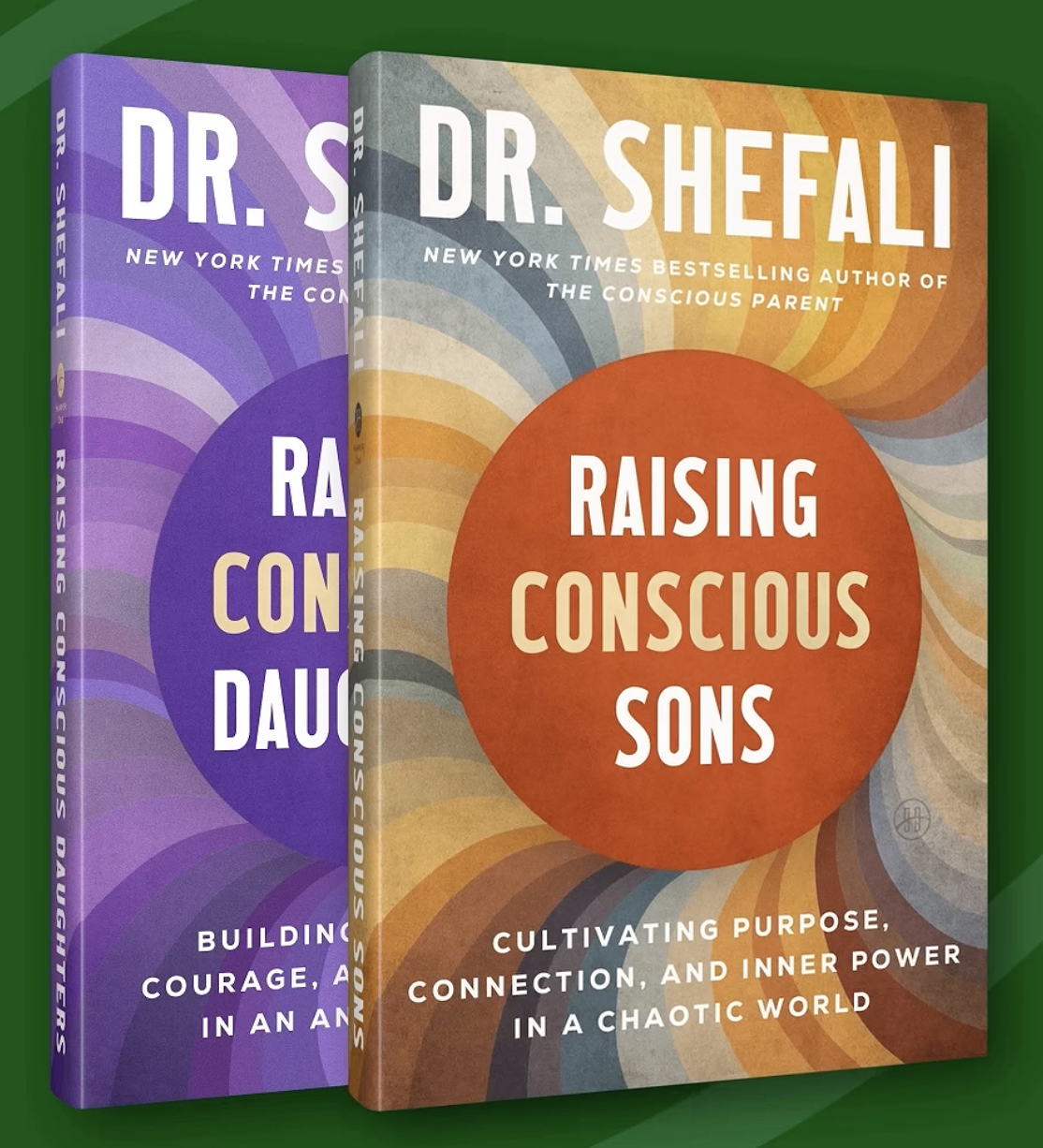
What interests me most about these books is that they are not simply about changing or managing a child's behaviour. They invite us to look underneath it. Our children are absorbing technology, social media, comparison, performance pressure, and increasingly complicated messages about identity, success, femininity and masculinity, often without us realising how much of it is landing. These books offer a way to understand that world more deeply while bringing the focus back to something that can easily get lost amongst all the noise: our relationship with the child actually in front of us.
Why Dr Shefali's Work Means So Much to Me
Many of you will already know that Dr Shefali's teachings form an important foundation of my work at Little Ones Life Coach. I trained as a Conscious Parenting and Life Coach through Dr Shefali's institute and have spent years studying and applying these principles, both in my own life as a parent and in my work supporting other parents.
My learning did not end when I completed my certification. I have had the privilege of meeting Dr Shefali in person and continue to learn through her graduate and alumni community, including ongoing teachings, group meetings and workshops. This continued learning matters deeply to me.
Parenting work asks us not only to understand our children, but to keep looking at ourselves too: our triggers, our fears, our expectations, the patterns we inherited, and the moments when our desire to protect our child can quietly turn into trying to control them. These are principles at the heart of conscious parenting: becoming aware of what we bring into the relationship so that we can respond to the child who is actually in front of us, rather than reacting from our own fear or conditioning.
I was also honoured to contribute as part of a panel of parents whose experiences and perspectives informed Dr Shefali's research for Raising Conscious Sons. As a mother raising two boys myself, this subject is especially close to my heart. Being part of this community allows me to keep learning and then translate those deeper principles into practical, compassionate support that parents can use in real family life.
Two Powerful Conversations With Oprah
As part of the launch of the books, Dr Shefali joined Oprah Winfrey for two in-depth conversations, one about raising sons and another about raising daughters. They are well worth making time for. The conversations move beyond surface behaviour and explore some of the emotional and cultural pressures children are experiencing today, alongside the patterns we as parents can unknowingly bring into our relationships with them.
Among the themes explored are:
The emotional isolation that many boys can experience
Helping sons express emotions without shame
The pressures girls can experience around appearance, perfection and achievement
Helping children develop an authentic sense of self
Screens, social media and online culture
Connection, boundaries and emotional safety
Recognising when our own fears and conditioning are influencing our parenting
Learning to respond with greater awareness rather than automatically reacting
If you have worked with me before, you may recognise some of these ideas from our coaching sessions, workshops or the resources I share. One of the messages I return to again and again is this: conscious parenting is not about becoming a perfect parent or raising a perfectly behaved child. It is about awareness. It is noticing what happens inside us when our child struggles, resists, withdraws or behaves in a way we were not expecting. That small shift can change the direction of an interaction.
I have written more fully about what boys and girls each tend to carry, and practical ways to build connection with a child of any gender, in Raising Conscious Sons and Daughters: A UK Coach's Guide.
What Might Our Sons Be Carrying That They Do Not Know How to Express?

Many boys grow up absorbing a quiet but persistent message that certain feelings, particularly sadness, fear and vulnerability, are less acceptable than others. This rarely arrives as an explicit instruction. It arrives through small moments: being told to toughen up after a fall, being praised for staying calm rather than for expressing distress, or noticing that anger draws attention while sadness does not.
Over time, this can leave boys with a narrower emotional vocabulary, not because they feel less, but because they have had less practice naming the fuller range of what they feel. What often surfaces instead is anger, withdrawal, or a flat, closed-off response, even when the underlying feeling is closer to disappointment or worry.
If your son's anger or reactivity feels like a daily struggle rather than an occasional flashpoint, our guide on whether conscious parenting actually works looks honestly at what this approach can and cannot do.
What Pressures Are Our Daughters Absorbing About Who They Should Be?

Girls in the UK today are often growing up in an environment that looks, on the surface, more equal and encouraging than it did a generation ago, while quietly asking them to be exceptional in almost every area at once: academically capable, socially likeable, physically attractive, endlessly composed. This combination can produce a particular kind of pressure that is harder to see precisely because it looks like success from the outside.
Social media adds another layer, offering girls a constant stream of curated comparison at exactly the age when identity is still forming.
If perfectionism or constant self-criticism is a pattern you recognise in your daughter, our guide on how to raise a confident child looks at the difference between confidence and self-esteem, and what genuinely helps build both.
How Can We Help Our Children Grow Into Themselves?
And how can we help our children grow into themselves without unintentionally allowing our own fears, expectations and conditioning to shape who they believe they need to become? This is, for me, the heart of conscious parenting, and it applies whether you are raising a son, a daughter, or both.
A few things that tend to help:
Naming emotions for your child before they are expected to name them, rather than waiting for them to find the words themselves
Responding to difficult behaviour with curiosity about what is underneath it, rather than only addressing what is on the surface
Letting your child see you, as a parent, experience and name a full range of emotions, including the ones that are not comfortable
Separating a boundary from your approval of the child, so a limit on behaviour never reads as a withdrawal of love
Repairing after the moments that do not go well, so your child learns that a relationship can be repaired rather than broken
What Would You Ask Dr Shefali?
Naturally, I have questions of my own, both as a mother and as a parenting coach, about what our children need from us today. If you could ask Dr Shefali one question about something you are struggling with as a parent right now, what would it be?
Perhaps your child seems angry, and you cannot reach them. Perhaps your teenager is disappearing further into their phone or gaming. Perhaps anxiety or perfectionism is taking over. Perhaps boundaries have become a daily battle. Perhaps your child is withdrawing from you and you do not know how to reconnect. Or perhaps the struggle is happening inside you: you recognise that you are becoming triggered, shouting or reacting in ways you regret, but in the moment, you cannot seem to stop yourself.
Whatever your question is, I would love to hear it. Book a free 15-minute discovery call and bring your question with you, or simply get in touch to share it.
Conclusion: The Child in Front of You
Raising conscious sons and daughters is not about applying a different set of rules to boys and girls. It is about staying curious enough to notice what your own particular child is carrying, absorbing, and quietly learning about who they need to be, and being willing to gently counterbalance the messages that do not serve them. Whichever child you are raising, and whichever book speaks more to your family, the underlying question is worth sitting with: what is my child learning about who they need to be in order to be loved and accepted? That takes ongoing awareness rather than a fixed formula, and it asks as much of us as parents as it does of our children.


