
New Term Routine Reset: Settling Back Into Structure After the Holidays
If your child seems more tired, tearful or short-tempered several weeks into the new school term, rather than on the first day back, you are not imagining it and you are not doing anything wrong. A back to school routine reset UK families often expect to be instant rarely is. Most children need several weeks, not several days, to adjust to earlier starts, a longer day, and the return of structure after the freedom of the holidays. The wobble often shows up later than parents expect, once the novelty of a new term has worn off and the accumulated tiredness catches up. This guide looks at why meltdowns tend to peak a few weeks in rather than on day one, how to reset a bedtime routine after the summer holidays gently, and practical ways to help your child settle back into structure without turning every evening into a battle.
Why Is My Child So Tired and Emotional in the First Weeks of Term?
The summer holidays usually mean later bedtimes, later mornings, and far less structure than term time asks for. When school starts again, children are suddenly expected to wake earlier, concentrate for longer, manage more social demands, and follow a much tighter schedule, often all at once.
Adults tend to notice tiredness and adjust their pace. Children, especially younger ones, often do not have that same ability to self-regulate yet. Instead of saying "I'm exhausted," a tired child is far more likely to show it through crying over small things, resisting instructions they would normally follow, or becoming clingy, silly, or defiant in ways that can look like they are simply misbehaving.
This is not a discipline problem. It is a capacity problem. A child running on a sleep deficit and a sudden jump in daily demands has less emotional bandwidth available, which means smaller things tip them into a meltdown far more easily than they would on a well-rested day.
Why Are Meltdowns Worse a Few Weeks Into the New School Year, Not on Day One?
Many parents expect the hardest day to be the first day back, and are then caught off guard when things actually get harder in week two or three. There is a reasonable explanation for this pattern.
On day one, children are often running on adrenaline and novelty. New shoes, a new classroom, seeing friends again, the excitement can genuinely carry a child through the first day or two on willpower alone. What tends to happen next is that the accumulated sleep debt, the sensory load of a full school day, and the mental effort of following a new routine all catch up at once, usually somewhere between week two and week four.
By that point, the initial excitement has worn off, but the child's body has not yet fully adjusted to the new sleep and activity pattern. That gap is where a lot of the meltdowns, tears, and out-of-character behaviour tend to concentrate.
If your child is not just tired but genuinely anxious about the return to school, our guide on helping a child who is terrified of starting a new school year looks specifically at how that anxiety shows up and what helps.
How Long Does It Take a Child to Adjust to a New School Routine?

There is no single fixed number, since every child's temperament, age, and sleep needs are different, but most children take somewhere between two and six weeks to properly settle into a new routine's rhythm. Younger children and children who are more sensitive to change often sit at the longer end of that range.
A few signs that your child is still adjusting, rather than something more concerning, include:
Tiredness or tearfulness that is worse at the end of the school week than the beginning
Meltdowns that cluster around transitions, such as getting dressed, leaving the house, or bedtime
Behaviour that is noticeably better on weekends or holidays, when the pressure of the routine lifts
A child who seems "fine" at school but falls apart the moment they get home, often because home is where it finally feels safe to release the effort of holding it together all day
That last pattern, often called after-school restraint collapse, is extremely common and is usually a sign that your child is coping well at school, not badly at home.
How Do I Reset My Child's Bedtime After the Summer Holidays?
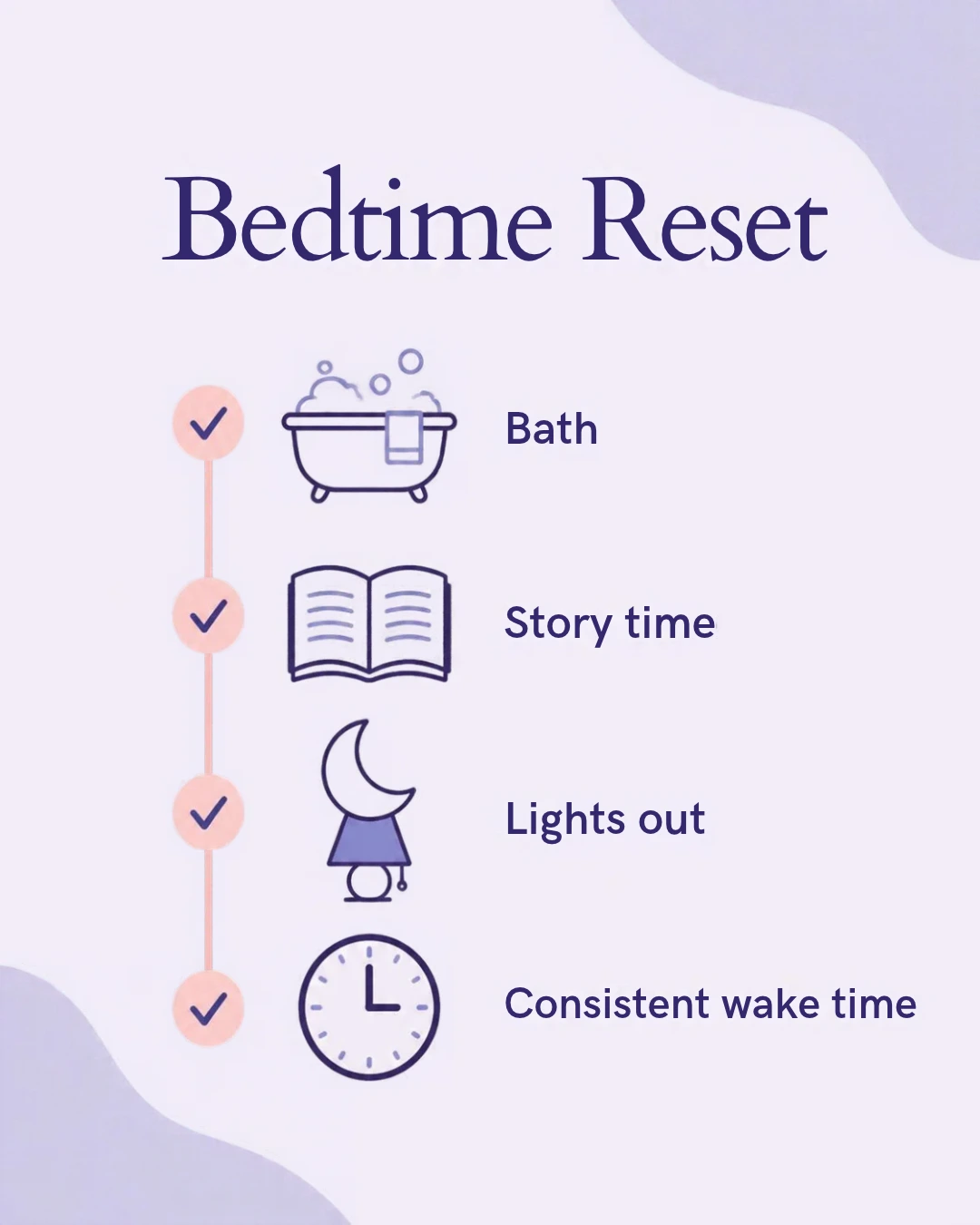
Bedtime is usually the single biggest lever available to parents during a routine reset, because so much of a child's ability to cope with the school day depends on the sleep they had the night before. A few practical ways to bring bedtime back in gently, rather than all at once:
Move bedtime earlier gradually, not overnight. Shifting bedtime by 15 minutes every few days is usually far more sustainable than jumping straight from a 9pm summer bedtime to a 7pm term-time one, and it is much less likely to trigger a fight.
Keep the wind-down routine consistent, even if bedtime itself shifts. A predictable sequence, bath, story, lights out, for example, signals to your child's body that sleep is coming, regardless of the exact time on the clock.
Get morning light and activity early in the day. Natural light in the morning helps reset the body's internal clock faster than darkness at night does, so a walk to school or time outside before the school day starts can genuinely help evenings settle sooner.
Reduce screens in the hour before bed. This matters even more during a reset period, since screens can make it harder for an already dysregulated nervous system to wind down.
Expect some resistance and hold the boundary calmly. A child who has had a summer of later bedtimes may well push back against an earlier one. Staying calm and consistent, rather than negotiating each night, tends to shorten the adjustment period rather than prolong it.
How Can I Help My Child Cope With the Return to Structure?
Bedtime is one part of the picture, but the wider return to structure, earlier mornings, homework, after-school clubs, less free time, asks a lot of a child all at once. A few things that tend to make the wider reset easier:
Rebuild the routine in layers, not all at once. Trying to fix bedtime, mornings, screen time, and after-school behaviour simultaneously in the first week back is usually overwhelming for everyone. Settling bedtime first, then building the rest around it once that is more stable, tends to work better than tackling everything at once.
Name what is happening, out loud, for your child. Something as simple as "your body is still getting used to school days again, that's why bedtime and mornings feel hard right now" helps a child understand that what they are feeling is expected and temporary, rather than something wrong with them.
Protect some downtime, even on busy days. The instinct after a summer of freedom can be to fill the calendar again straight away. Leaving some unstructured time in the week, even just twenty minutes with nothing planned, gives your child's nervous system room to recover between the demands of the day.
Expect more meltdowns at home than at school, and try not to take it personally. Many children hold it together impressively well during the school day and then fall apart the moment they are somewhere safe. That collapse at home is usually a sign of trust, not a discipline problem.
If your child's return to routine feels harder than it should, and lasts well beyond the first month, our article on what actually happens in parenting coaching sessions explains what support can look like if you would like some help working through it together.
When Might This Be More Than Just an Adjustment Period?
Most tiredness, tears, and short tempers in the first month of term settle on their own as sleep and routine catch up. It is worth paying closer attention if the difficulties are not easing after four to six weeks, if your child seems persistently anxious about school rather than simply tired, or if you are noticing signs of withdrawal, ongoing sleep difficulties, or a marked change in appetite or mood that does not lift.
None of this means something has gone seriously wrong. It simply means the adjustment may need a bit more structured support than time alone, which is exactly where working with a coach or speaking with your GP or school can help.
Conclusion: Give the Adjustment the Time It Actually Needs
A new term routine reset is rarely instant, and the wobble that shows up two or three weeks in is not a step backwards, it is simply your child's body and mind catching up with a much bigger shift than it looks like from the outside. Rebuilding bedtime gradually, protecting some downtime, and expecting the hardest days to land a little later than you might assume, all give the adjustment the time it genuinely needs. With patience and a calm, consistent routine, most children find their footing well before half term.
Related Posts You Might Find Helpful
My Child Is Starting Year 7 and Is Terrified - How Do I Help Them?
Sensory Processing at Home: What Your Child's Behaviour Is Telling You


