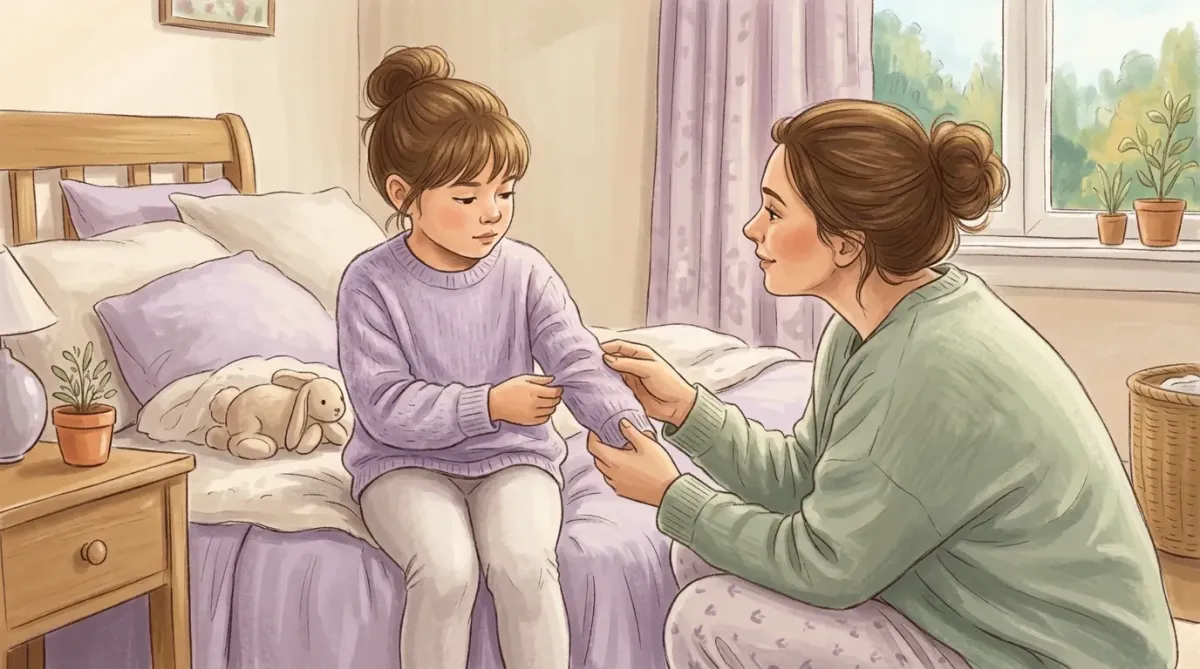
Sensory Processing at Home: What Your Child's Behaviour Is Telling You
If your child covers their ears at ordinary noise, refuses certain clothes, gags at specific food textures, or melts down in busy places, you may be watching sensory processing differences play out rather than defiance or fussiness. Sensory processing is how the brain takes in and makes sense of information from the senses, including touch, sound, sight, smell, taste, movement, and the body's internal signals. When this process works differently, everyday moments such as getting dressed, sitting at a busy dinner table, or walking through a supermarket can feel genuinely overwhelming to a child, even though nothing outwardly difficult is happening. This guide explains what sensory processing differences actually look like at home, how to tell a sensory meltdown from a tantrum, what helps day to day, and when it is worth asking for professional support.
Why This Behaviour Can Be So Hard to Read

Sensory reactions rarely arrive with a label attached. A child who screams when a jumper touches their skin, or who cannot sit still at the table, or who falls apart the moment a room gets loud, is often labelled fussy, dramatic, or badly behaved before anyone considers that their nervous system might genuinely be registering the world differently.
Bakshi Sidhu is a CPMC certified conscious parenting and life coach with a BSc in Psychology, a Masters in Anthropology of Children and Child Development, and a PGCE in Primary Education. She spent more than ten years as a primary school teacher and five years running a nursery, watching children of every sensory profile move through a school day. Her view is that behaviour is information. A child is not choosing to struggle with a seam in their sock or a hand dryer in a public toilet. Their body is genuinely telling them something is too much, and the behaviour you see is the outward sign of that internal experience.
What Is Sensory Processing, and Why Does It Sometimes Go Differently?
Sensory processing is the way the brain receives, organises, and responds to information coming in through the senses. This includes the five familiar senses of touch, sound, sight, smell, and taste, as well as two lesser known systems: the vestibular sense, which governs balance and movement, and proprioception, which is the body's awareness of where it is in space. A further internal sense, interoception, governs awareness of hunger, thirst, and other bodily signals.
For most children, this processing happens automatically and efficiently, filtering out background information and responding appropriately to what matters. For some children, this filtering does not work as smoothly. Sensory information can feel too intense, not intense enough, or unpredictable from one day to the next, which can make ordinary tasks like getting dressed, eating, or sitting through a lesson far harder than they look from the outside.
It is worth being clear here: the Royal College of Occupational Therapists has stated that the term Sensory Processing Disorder is not recognised as an independent diagnosis, and it is generally understood as a set of differences that can accompany conditions such as autism, ADHD, or developmental coordination disorder, or that can occur in a child with no other diagnosis at all. A child does not need a diagnosis for their sensory experience to be real and worth supporting.
Why Does My Child Cover Their Ears or Refuse Certain Clothes?
These are two of the most commonly reported sensory behaviours, and both usually point to the same underlying pattern: the sensory input is arriving at an intensity the child's nervous system cannot comfortably process.
Covering ears or reacting strongly to noise often means a child is hyper-sensitive to sound. Everyday noises that barely register for most people, a hand dryer, a vacuum cleaner, a busy classroom, a school hall at lunchtime, can feel painfully loud or chaotic to a sound-sensitive child. This is not attention-seeking. It is a genuine attempt to reduce input that has become overwhelming.
Refusing certain clothes usually reflects tactile sensitivity. Seams, tags, certain fabrics, tight waistbands, or the sensation of new clothing against skin can register as persistently uncomfortable or even painful, rather than as a minor annoyance. A child who insists on wearing the same soft joggers every day, or who cannot tolerate a school jumper, is often not being difficult. They are managing a sensation that genuinely bothers them more than it would bother most people.
Both patterns tend to intensify when a child is already tired, hungry, anxious, or has had a demanding day, because the nervous system has less capacity left to manage additional sensory input on top of everything else.
Is This a Sensory Issue or Just Fussy Behaviour?
This is one of the most common questions parents ask, and there is no single test that answers it definitively. A few practical questions can help you tell the difference.
Is the reaction consistent? A child with genuine sensory sensitivity tends to react the same way to the same trigger fairly consistently, whereas ordinary fussiness is often more variable and more responsive to mood, attention, or negotiation.
Does it happen across different settings? Sensory reactions usually show up in more than one place, at home, at school, at a relative's house, rather than being confined to situations where a child might be seeking something specific, like avoiding a task they dislike.
Is the child distressed, or trying to get something? Fussy or attention-seeking behaviour is usually goal-directed. Sensory reactions are usually about genuine discomfort or overwhelm, even when the child cannot fully explain what is wrong.
Does it ease with accommodation rather than firmness? If cutting out a label, switching to a softer fabric, or lowering the noise in a room genuinely helps, that is a strong sign the reaction was sensory rather than behavioural.
None of these questions are perfect on their own, but together they usually paint a clearer picture. And it is worth remembering that a child can be both genuinely sensory sensitive and, at other moments, simply asserting normal childhood preferences. The two are not mutually exclusive.
What Are the Signs of Sensory Processing Difficulties in Children?

Sensory differences show up differently depending on whether a child is over-responsive, under-responsive, or actively seeking sensory input. Many children show a mix of all three, depending on the sense involved.
Signs of over-responsiveness (hyper-sensitivity):
Distress at loud, sudden, or ongoing noise
Avoidance of certain food textures, tastes, or temperatures
Refusing specific fabrics, tags, seams, or tight clothing
Discomfort with messy play, glue, sand, or getting hands dirty
Covering eyes in bright light or avoiding certain visual environments
Strong reactions to unexpected touch, including light touch such as a gentle tap
Signs of under-responsiveness (hypo-sensitivity):
Not noticing pain, cold, or minor injuries that would bother most children
Seeming unaware of messy hands, face, or clothing
Not responding to their name or to background noise
Appearing to need very strong input before registering anything at all
Signs of sensory seeking:
Constant movement, jumping, crashing into things, or climbing
Chewing on clothing, pencils, or objects that are not food
Touching everything in a room or seeking out textures
Craving spinning, swinging, or other intense movement
If your child shows several of these patterns consistently, particularly across more than one setting, it is a reasonable signal that sensory processing is playing a role in their behaviour, even without a formal diagnosis.
How Can I Help My Child With Sensory Sensitivities at Home?

Most sensory support at home is not about eliminating every trigger. It is about reducing unnecessary sensory load, building in regulation opportunities, and working with your child's nervous system rather than against it.
Reduce sensory clutter where you can. A calmer visual environment, fewer competing sounds, and a predictable routine all lower the background load a sensory-sensitive child is carrying, leaving more capacity to cope with the parts of the day that cannot be simplified.
Offer a sensory toolkit, not a single fix. Different children are soothed by different input. Some find deep pressure calming, such as a weighted blanket or a firm hug. Others need movement, such as a trampoline break or a wobble cushion at the table. A small, accessible set of options lets your child self-regulate rather than waiting for a meltdown to happen. The guide on the best sensory toys for a child with ADHD has practical, affordable suggestions organised by the type of input they provide.
Prepare for transitions and new environments. Warning your child in advance about noise, crowds, or an unfamiliar setting gives their nervous system time to brace rather than being caught off guard, which is often when sensory overload turns into a full meltdown.
Adjust clothing without a fight. Removing tags, choosing seam-free socks, or accepting that your child wears the same comfortable outfit repeatedly is not giving in. It is removing an unnecessary sensory battle so your child has more capacity for the things that genuinely need their effort.
Watch for the build-up, not just the trigger. A meltdown at pick-up time is rarely about the immediate moment. It is often the accumulated sensory and emotional load of an entire school day finally tipping over. If this pattern feels familiar, the article on why your child has meltdowns over small things explores this build-up in more depth.
Stay regulated yourself. A child in sensory overload is not in a state to reason or negotiate. Your calm, steady presence, even without solving anything in the moment, helps their nervous system find its way back to a place where they can cope again.
What's the Difference Between a Sensory Meltdown and a Tantrum?
This distinction matters because the two need very different responses, and treating a meltdown like a tantrum, or the other way round, usually makes things worse rather than better.
A tantrum is typically goal directed. A child wants something, does not get it, and expresses frustration in an intense but ultimately purposeful way. Tantrums usually ease once the child either gets what they wanted, is distracted, or learns that the behaviour will not achieve the outcome.
A sensory meltdown is different. It is an involuntary response to being overwhelmed, whether by sensory input, emotional load, or a combination building up over time. The National Autistic Society describes a meltdown as an intense response to an overwhelming situation, where a person temporarily loses control of their behaviour. A meltdown cannot be talked out of or bargained away in the moment, because the child is not choosing the behaviour. Their capacity to cope has simply been exceeded.
The most useful signal is what happens if the perceived problem is removed. A tantrum often stops, at least partially, once the child's want is addressed. A meltdown continues regardless, because it was never about getting something in the first place. It was about relief from overwhelm, which takes time and a calmer environment rather than negotiation.
Does My Child Need an Occupational Therapist for Sensory Issues?
Not every sensory sensitivity needs professional input, but there are signs worth taking to your GP or school SENCO for onward referral to occupational therapy.
Consider seeking an assessment if sensory differences are significantly limiting daily life, for example if your child cannot tolerate school uniform, struggles to eat enough variety of food, avoids activities most of their peers enjoy without distress, or if meltdowns related to sensory overload are frequent, intense, or getting worse rather than easing with the strategies above. It is also worth raising if sensory differences are affecting school attendance or your child's ability to access learning.
Sheffield Children's NHS Foundation Trust, whose sensory service supports children with sensory processing differences, notes that children may show sensory-related difficulty whether or not they have another diagnosis such as autism or ADHD, and that the focus of support is adapting tasks and the environment and building a child's capacity for self-regulation, rather than pursuing a standalone diagnosis of sensory processing difficulties. Full guidance is available at sheffieldchildrens.nhs.uk.
An occupational therapy referral, usually made through your GP or your child's school, can offer a structured assessment, practical strategies tailored to your child's specific sensory profile, and support for school staff so consistent adjustments happen in both settings.
When Sensory Sensitivity Overlaps With Anxiety, ADHD, or Food Refusal

Sensory processing rarely sits in isolation. It frequently overlaps with anxiety, since an overloaded nervous system and an anxious one can look remarkably similar, and each can intensify the other. Children with ADHD often show heightened sensory responses too, alongside the more commonly recognised attention and impulsivity traits. And sensory sensitivity around texture, smell, and appearance is one of the most common underlying reasons a child becomes a highly selective eater, well beyond typical toddler fussiness.
If your child's worry seems to extend well beyond sensory triggers into many areas of life, the article on what it means when a child worries about everything explores how sensory processing differences and anxiety frequently occur together, and what genuinely helps both.
And if mealtimes are a particular flashpoint, whether it is food textures, smells, or the sensory experience of the dining hall, the guide on choosing between school dinners and a packed lunch for a fussy eater covers the practical side of managing sensory-driven food refusal at school.
Conclusion: Behaviour Is Communication, Not a Character Flaw
If you take one thing from this, let it be this: your child's sensory reactions are not a sign that they are difficult, dramatic, or badly behaved. They are a genuine reflection of how their nervous system is experiencing the world in that moment. A child who covers their ears, refuses a jumper, or melts down in a busy shop is not choosing to struggle. Their body is telling you something real, and the most useful response is curiosity rather than correction.
Understanding sensory processing does not mean removing every difficulty from your child's life. It means recognising which battles are worth having and which ones are simply unnecessary sensory load your child does not need to carry. With patience, some practical adjustments, and support when you need it, most children learn to manage their sensory world with growing confidence, and so do their parents.
Related Posts You Might Find Helpful
Best Sensory Toys for an ADHD Child (UK Guide for Parents 2026)
My Child Worries About Everything: Is This Anxiety and What Do I Do?
School Dinners or Packed Lunch for a Fussy Eater? A UK Parent's Guide


