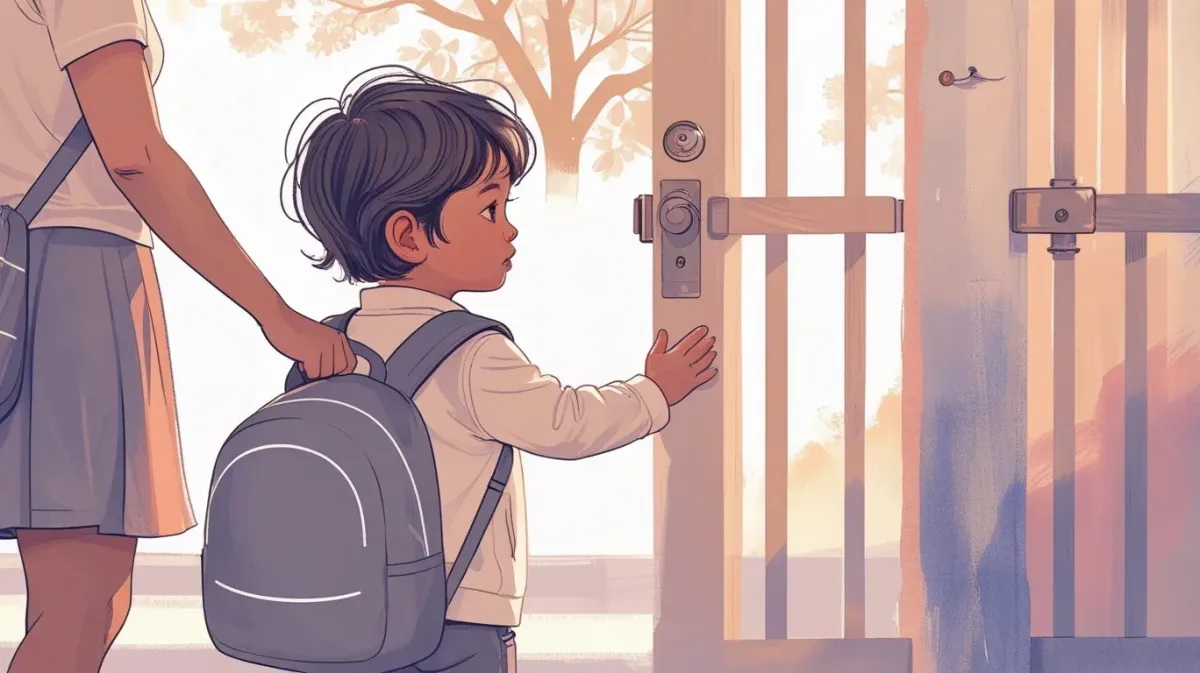
My Child Is Anxious About Going Back to School: What Do I Do?
If your child is anxious about going back to school, the most important thing to know is that this is one of the most common things children experience at the end of the summer holidays. Back-to-school anxiety is real, it is normal in varying degrees, and it is manageable with the right approach. The signs range from stomach aches and sleep problems to clinginess, tearfulness, and a refusal to talk about September. What drives it is not weakness or difficulty but the natural stress response of a child's nervous system facing uncertainty. Your child is asking the questions every child asks: will I belong, will I be safe, will I cope? This article explains what back-to-school anxiety looks like at different ages, what makes it worse, and the specific, practical steps that help most. It also covers when to seek professional support and where to find it.
Introduction: Why Going Back to School Can Feel So Big

Every August, thousands of UK parents watch their child become a different person. The child who seemed perfectly fine in July is now waking up at night, complaining of stomach aches, and crying at the mention of September. And many parents are left wondering what happened, and what they are supposed to do.
Bakshi Sidhu is a CPMC certified conscious parenting coach, former primary school teacher of over ten years, nursery owner of five years, and mother of two. She has supported families through school anxiety at every level, from the child who cries at drop-off for two weeks to the child whose anxiety becomes serious school refusal. Her view is consistent: back-to-school anxiety is almost always telling you something about what your child needs, and responding to it thoughtfully makes an enormous difference.
This article is for every parent watching their child dread September and wondering how to help without making things worse.
What Is Back-to-School Anxiety and Why Does It Happen?
Back-to-school anxiety is the stress, worry, and apprehension that children experience in anticipation of returning to school after a break. It is not a clinical diagnosis in itself but a very common response to transition and uncertainty.
Going back to school asks a great deal of children. Even children who genuinely enjoy school are being asked to step back into an environment full of unknowns after weeks of summer freedom. The questions running through a child's mind are rarely trivial to them:
- Will my friends still want to be my friends?
- What if I am in a different class from the people I know?
- What if the teacher is strict?
- What if the work is too hard?
- What if something embarrassing happens?
- What if nobody sits with me at lunch?
These questions feel enormous to a child because the things they are asking about - belonging, safety, competence, and connection - are the things that matter most at every stage of childhood. They are not being dramatic. They are doing the very normal work of trying to predict whether the environment they are about to re-enter will be safe and welcoming for them.
The NHS guidance on anxiety in children notes that anxiety becomes a concern when it is persistent, excessive relative to the situation, and begins to interfere with daily life. The guidance for parents can be found at nhs.uk/mental-health/children-and-young-adults/advice-for-parents/anxiety-in-children.
What Does Back-to-School Anxiety Look Like? Signs by Age
In younger children aged 4 to 7
Younger children often cannot name their anxiety as anxiety. Instead, it shows up in their bodies and their behaviour. Common signs in this age group include:
- Stomach aches and headaches that appear on weekdays and ease at weekends
- Difficulty sleeping or frequent night waking in the weeks before school returns
- Clinginess and separation difficulties that were not present before the holidays
- Regression in behaviours such as bedwetting, thumb-sucking, or baby talk
- Meltdowns and emotional outbursts that seem disproportionate to the trigger
- Reluctance to talk about school or shutting down when it is mentioned
At this age, children are also highly attuned to their parents' emotional state. If you are anxious about September, your child will feel it even if you say nothing.
In children aged 7 to 11
Older primary-age children are more likely to be able to articulate some of their worries, though they may not always volunteer them. Signs at this age include:
- Specific voiced worries about friendships, teachers, or academic work
- Persistent physical complaints with no identified medical cause
- Increased irritability or emotional sensitivity in the weeks before term
- Withdrawal from activities they normally enjoy
- Asking repetitive reassurance-seeking questions about school
- Sleep difficulties and changes in appetite
Children at this age are also beginning to compare themselves to peers more acutely. Worries about social standing, about being good enough, and about fitting in become more prominent.
In children aged 11 to 14 starting secondary school
The transition to secondary school is one of the most significant anxiety triggers in childhood. A child moving to Year 7 is navigating a completely new environment, a new social landscape, and a level of independence they have not experienced before. Signs of anxiety at this stage can include:
- Intense worry about getting lost, being late, or not knowing the rules of the new school
- Worries about bullying or social rejection
- Physical symptoms that intensify in the final weeks of August
- Anger or irritability that masks underlying anxiety
- Withdrawal from family and friends
If your child is starting Year 7 this September and is struggling significantly, the dedicated article on helping a child who is terrified of secondary school on this site covers this transition in depth: https://littleoneslifecoach.com/post/prepare-child-secondary-school-transition
What Makes Back-to-School Anxiety Worse?

Excessive reassurance
One of the most common and well-intentioned mistakes parents make is offering constant reassurance. 'You will be fine, it will be great, everyone feels like this.' The problem is that reassurance is addictive and temporarily effective. It makes the child feel better for a short time, then the anxiety returns, and they need more reassurance to feel okay again. Over time, the child becomes reliant on reassurance rather than building their own capacity to tolerate uncertainty.
This does not mean you never reassure your child. It means that reassurance alone is not the solution, and too much of it can actually deepen anxiety rather than reduce it.
Avoidance
When anxiety is high, avoidance feels like relief. The child says they cannot go to school and staying home feels better in the short term. But every time a child avoids the thing that triggers their anxiety, the anxiety grows. The feared situation has not been shown to be survivable. Avoidance confirms the threat.
This is why school attendance, even when it is hard, is generally the right approach for most children with back-to-school anxiety. The goal is not to eliminate the anxiety before returning to school. It is to support the child through it, so their nervous system learns that school is safe.
Parental anxiety
Children are extraordinarily sensitive to their parents' emotional state. Research consistently shows that parental anxiety is one of the strongest predictors of child anxiety. If you are dreading September, your child will feel it. This does not mean you are a bad parent. It means you are human, and September can be stressful for adults too, for many reasons.
The most useful thing you can do for your anxious child is work on your own regulation first. This is explored in depth in the article on parental burnout on this site: https://littleoneslifecoach.com/post/parental-burnout-uk
Unacknowledged worry
Children whose worries are dismissed, minimised, or met with excessive positivity often stop sharing them. They learn that their anxiety is not welcome, which means it goes underground rather than being processed. The child who seems suddenly fine may not be fine at all. They have simply stopped telling you.
Creating space for worry, naming it without drama, and taking it seriously without amplifying it is the foundation of helping an anxious child.
What Actually Helps: Practical Strategies for Back-to-School Anxiety
Start talking about school early but briefly
Do not wait until the week before term to introduce the subject. Bring school into conversation naturally and lightly from mid-August onward. Not with questions like 'are you worried about school?' but with curious, low-pressure openers: 'I wonder who your teacher will be this year' or 'I was thinking we could go past the school one afternoon before term starts, just to walk past.'
Short, frequent conversations are far more effective than one big reassurance conversation the night before. They normalise school as a topic and give your child multiple small opportunities to share what is on their mind.
Validate the worry, then gently expand
When your child shares a worry, the first response should always be validation. Not agreement with the catastrophic interpretation, but acknowledgement that the feeling is real and makes sense.
'I can understand why you are worried about not knowing where things are, that sounds really hard' is validating. 'There is nothing to worry about, everyone gets lost at first' dismisses.
Once the feeling has been acknowledged, you can gently help your child look at the situation from a slightly wider angle. 'What do you think you could do if you got lost? Who might you ask?' This builds problem-solving capacity rather than dependence on your reassurance.
Reintroduce routine before term starts
The body clock matters. If your child has been going to bed an hour later and waking up an hour later through the summer, the first week of school will feel physically brutal as well as emotionally challenging. Begin shifting bedtime and wake time back towards school hours in the two weeks before term, gradually rather than all at once.
Reinstate the rough shape of the morning routine too. Getting up, getting dressed, eating breakfast, and leaving the house at a similar time to school mornings. This reduces the shock of the first day significantly.
Visit the school environment in advance if you can
Familiarity reduces anxiety. If your child's school allows it, a visit before term starts gives your child the chance to locate key places - the classroom, the toilets, the lunch hall - in a low-pressure context. Many secondary schools offer transition days for this purpose. For primary-age children, even walking past the school and talking about what September will look like helps the unfamiliar feel more known.
Prepare a goodbye ritual for drop-off
Drop-off is often the flashpoint for back-to-school anxiety. Having a consistent, brief goodbye ritual gives the child something predictable to hold onto. It might be a specific hug, a phrase you always say, or a small object they carry. What matters is that it is the same every day and that you leave confidently rather than lingering. A drawn-out goodbye increases anxiety rather than easing it.
The article on managing parent-child separation on this site has detailed guidance on making drop-off less distressing for both of you: https://littleoneslifecoach.com/post/managing-parent-child-separation-how-to-support-your-child-and-yourself
Check in after school, not before
Many parents ask their anxious child how they are feeling about school on the way to school, which is precisely the worst moment. The child is already in their anxiety. Adding the question activates it further.
Instead, ask after school, once your child is home, fed, and has had some decompression time. And ask with curiosity rather than interrogation. 'What was the best bit?' often opens more than 'how was your day?'
When Is Back-to-School Anxiety More Than Normal Nerves?

Most back-to-school anxiety settles within the first two to three weeks of term once routine is re-established and the feared situations have turned out to be survivable. The child who was crying at the gates in September is often happily settled by October half term.
But for some children, the anxiety does not settle. It escalates. This is the point at which professional support becomes important.
Signs that anxiety may need professional attention:
School refusal that is becoming entrenched and harder to manage each week
Physical symptoms that are frequent, severe, and not responding to reassurance or routine
Anxiety that is spreading beyond school to affect other areas of life
A child who is significantly distressed for more than three to four weeks after term starts
A pattern of escalating anxiety that is getting worse year on year
If your child's anxiety about going back to school is escalating or has become a pattern over multiple years, it is worth considering whether there is an underlying difficulty that has not yet been identified. Anxiety in children is frequently connected to unmet needs, whether that is an undiagnosed learning difficulty, ADHD, a social challenge, or a sensory processing difference. The article on why children overreact to small things explores the neuroscience behind this in more detail: https://littleoneslifecoach.com/post/why-child-overreacts-small-things
What to Say to School About Your Child's Anxiety
Many parents hesitate to contact the school about their child's anxiety, worried about being seen as overprotective or difficult. In almost every case, raising the concern early leads to a better outcome than waiting.
Before term starts, email or call your child's class teacher or the school SENCO. Keep it brief and factual. You do not need to have a diagnosis or a formal concern. You simply need to flag that your child has been anxious about returning and ask what support can be put in place.
Useful things to ask for:
A named adult your child can go to if they feel overwhelmed during the day
A gentle check-in on the first morning
Advance notice of anything that might change, such as a supply teacher or a change to the timetable, which can be particularly destabilising for anxious children
A brief daily communication for the first couple of weeks so you know how they are settling
Young Minds has a useful guide for parents on talking to schools about mental health, available at youngminds.org.uk. Their parent helpline is also available on 0808 802 5544, Monday to Friday.
What If My Child Has Always Found School Hard?
For some children, back-to-school anxiety is not a new response to a new school year. It is a continuation of something that has been present for a long time. A child who has consistently found school difficult, who has struggled socially, academically, or emotionally throughout their time in school, is communicating something that deserves to be taken seriously rather than managed through routine adjustments alone.
In these cases, it is worth exploring whether:
- There is an unidentified learning difficulty or processing difference making school genuinely harder for this child than for their peers
- ADHD or anxiety as a clinical condition is at play, rather than typical anxiety as a response to transition
- There is a social difficulty, bullying situation, or relational challenge that has not been resolved
- The school environment itself is not meeting this child's needs
If your child says they hate school, not just at transition times but consistently throughout the year, the article on what it really means when a child says they hate school covers this in depth: https://littleoneslifecoach.com/post/child-hates-school-uk
Looking After Yourself Through Back-to-School Season
It is easy to become so focused on your child's anxiety that you forget to notice your own. Back-to-school season is emotionally demanding for parents too. The logistics alone are significant. Add a child who is distressed, and it can feel relentless.
Some things that help:
- Connecting with other parents who are navigating similar challenges, because you are not as alone in this as it can feel
- Being honest with yourself about how much of the anxiety in the house belongs to you and how much belongs to your child
- Recognising that your child's anxiety, however exhausting it is to manage, is also a sign that they feel safe enough to show you how they feel
- Asking for help when you need it, whether from a partner, a friend, or a professional
If you are finding that your child's anxiety is significantly affecting your own wellbeing and your capacity to stay regulated, working with a parenting coach can give you both practical strategies and the kind of reflective support that helps you show up more calmly for your child.
Conclusion: Back-to-School Anxiety Is a Signal, Not a Problem to Suppress
When your child is anxious about going back to school, the anxiety is communicating something. It might be telling you that your child is sensitive to change and needs more preparation. It might be telling you that something about school has not felt safe for them. It might be telling you that they need more connection and reassurance from you before they can feel ready to step back into that world.
Your job is not to eliminate the anxiety before September. It is to help your child feel accompanied in it, so that they build the experience of moving through something hard and coming out the other side. That is how resilience is built. Not by removing the difficulty but by being alongside the child as they face it.
Back-to-school anxiety, handled well, becomes one of the experiences that teaches a child that they are more capable than they feared. And that you will always be there when they need you.
Related Articles You Might Find Helpful
- My Child Says They Hate School - What Is Really Going On? - https://littleoneslifecoach.com/post/child-hates-school-uk
- How to Prepare Your Child for Secondary School Without the Panic - https://littleoneslifecoach.com/post/prepare-child-secondary-school-transition
- Managing Parent-Child Separation: How to Support Your Child and Yourself - https://littleoneslifecoach.com/post/managing-parent-child-separation-how-to-support-your-child-and-yourself
- Why Does My Child Overreact to Small Things? - https://littleoneslifecoach.com/post/why-child-overreacts-small-things


